
BY N PRASHANT CHOWDARY
After months of rain, the sky has finally turned blue. Similarly, amidst the noise surrounding Trump, there are clear signals in his actions. Understanding these objectives is crucial for understanding markets, as economics is deeply intertwined with politics. The Trump administration believes that previous governments pursued harmful policies that damaged society and the real economy, and they aim to set things right.
Unstated Objectives
The Trump administration has several unstated objectives driving its actions. Its primary goal is to unwind globalist, liberal policies that have suppressed two generations of blue-collar workers and oppressed the middle class. This is a long-term policy that will take time to fully impact markets. Below, I outline some key objectives that appear
to be addressing:
1. Liberal Globalization: The world has progressed significantly due to free trade, butthe harsh reality of economics is that there is often one winner and one loser, even as the system as a whole advances. Free trade has devastated the Midwest, leading to losses in human and physical capital. For example, there is a 17-year life expectancy gap between college-educated and non-college-educated white men. This is a political issue, as much of Trump’s “MAGA” base consists of non-college-educated white men. To address this, the administration seeks to re-industrialize the real economy.
2. Big Government: The Trump administration believes that smaller government is more effective (DOGE is an experiment in this direction). Governments often increase spending to appease their base, crowding out capital from productive uses. This creates a significant divergence between physical and financial assets, which disproportionately harms the middle class.
3. Military Objectives: In the event of a war, the administration is focused on how quickly the nation can mobilize resources. A recent speech by Secretary of War Pete Hegseth reflects this priority. Notably, the administration has renamed the Department of Defense the Department of War.
4. Antitrust Actions Against Big Tech Monopolies: Big tech companies have become more powerful than some governments, and much of their investment and tax revenue is generated outside the U.S., resulting in negative net foreign investment for the government. The administration is pushing to bring capital and investment back to the U.S. through various means.
Currency Reset: For manufacturing to return to the U.S., the dollar must not be overvalued, a challenge exacerbated by its reserve currency status and the Triffin Dilemma. Drawing from historical precedents like the Nixon Shock and the Plaza, the administration aims to depreciate the dollar by 35 to 40 percent to boost domestic manufacturing and reduce import costs.
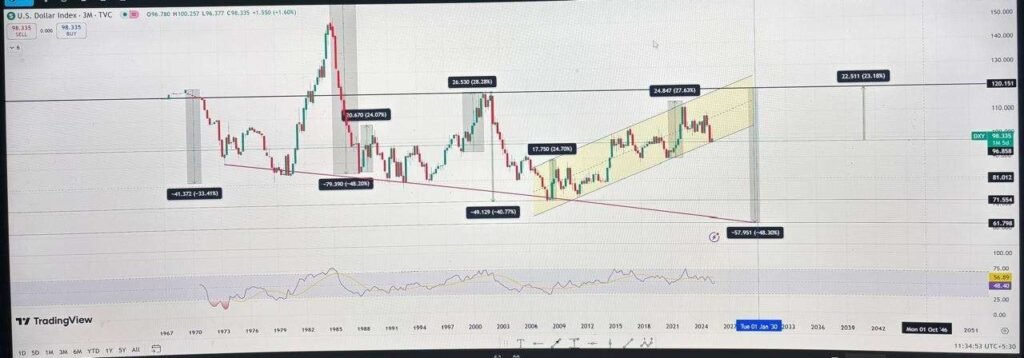
Methods Used To achieve these objectives, the current administration is employing the following strategies:
- Tariffs
- Subsidies
- Currency manipulation (e.g., Thai currency)
- Energy deregulation
- Non-tariff barriers
- Deliberately shrinking the capital account surplus (e.g., purchasing the Panama Canal, Greenland)
- National capitalism (e.g., supporting companies like Intel)
- Financial repression
- Immigration policies
Unintended Consequences Every action has a cause-and-effect relationship, but the effects can be multifaceted. Several unanswered questions remain about how markets and the economy will respond:
- How will tariffs impact inflation?
- If inflation rises, will the Federal Reserve increase interest rates or yield to political pressure?
- How will bond vigilantes react?
- What happens if the economy enters a recession?
- How will the administration address the Triple Deficit Hypothesis problem in the economy?
The stock market serves as a barometer of the economy, pricing in all available information. Currently, it appears to believe that Trump has a strategy to “Make America Great Again.” However, Trump, a former reality TV host and New York real estate mogul, may view markets as a game. The true outcomes will become clear when the markets stop “dancing.”